Field work gets harder to run when every job lives in a paper folder or a spreadsheet. As volume grows, errors creep into payroll, materials, and billing, and the real cost of a job only shows up after it closes.
We recently hosted a virtual session with Jared Reeves, Director of Technology at Cascade Stucco, alongside new TrackVia research from more than 250 field operations leaders. Jared walked through four areas where Cascade automated its work, and how each one helped the company grow while keeping costs under control. It follows our earlier session with Vee-Jay Cement.
Key takeaways
- Automated workflows and operations are necessary to scale your business.
- Start with the work that drives revenue. For Cascade, that was work order and job management.
- Connecting field ops to payroll and order systems can reduce costs including staffing, inventory and material costs.
- Running tighter operations creates a more professional image, and wins more business.
Watch on demand
Learn how Cascade Stucco, a Utah contractor founded in 2013 that works with large homebuilders, grew from three or four jobs a month to hundreds, and completed three mergers and acquisitions on one connected system. The session covers:
- Crew and vendor management
- Work order management and job profitability
- Inventory and materials control
- One pipeline from bid to field
The session was hosted by Daniel Dorr, SVP of Marketing at TrackVia. Speakers:
- Jared Reeves, Director of Technology at Cascade Stucco. Jared has been with Cascade on and off since 2014 and has built out its use of TrackVia since the company moved to the platform in 2015.
- Hosanna Collier, Implementation Engineer at TrackVia. Hosanna works with customers every day to build their operations in TrackVia applications.
The problems we hear most
TrackVia recently analyzed the operations of 250+ leading organizations. 70 percent of leaders said paper, spreadsheets, and email had slowed them down. The most common operations they automated and made available on mobile was field or quality inspection. In construction, work order management came first.
Most common operational challenges:
- Systems that do not talk to each other. Data sits in Excel, a separate field app, and Microsoft tools. Each may work on its own, but without a connection, there is no shared data to make decisions with.
- No audit history. When paper changes hands or people edit a spreadsheet, there is no record of what changed or when.
- Out-of-date information. A spreadsheet updated today is often out of date 24 hours later.
- Software that forces a fit. Many teams have tried tools that make them reshape their operations around the software, which makes the work harder instead of easier.
Cascade started in the same place. At three or four jobs a month, the company ran on printed plans, printed selection sheets, and printed everything else. Once it reached several jobs a week, papers got mixed up, and people handed documents to the wrong people. Its early digital tools were, in Jared’s words, “a glorified Excel sheet.” As Cascade grew with corporate leadership and several divisional teams all needing the same data, the problem multiplied.
Four best practices from Cascade Stucco
Cascade did not build everything at once. Jared started with the work that drove revenue and added more as new needs came up. The sections below cover the four areas he walked through.
1. Crew and vendor management
Cascade pays its crews on a piece-rate basis, so there is no simple punch-in and punch-out. Crews go out and install material, and it was hard to know where a team was or when a job would actually happen.
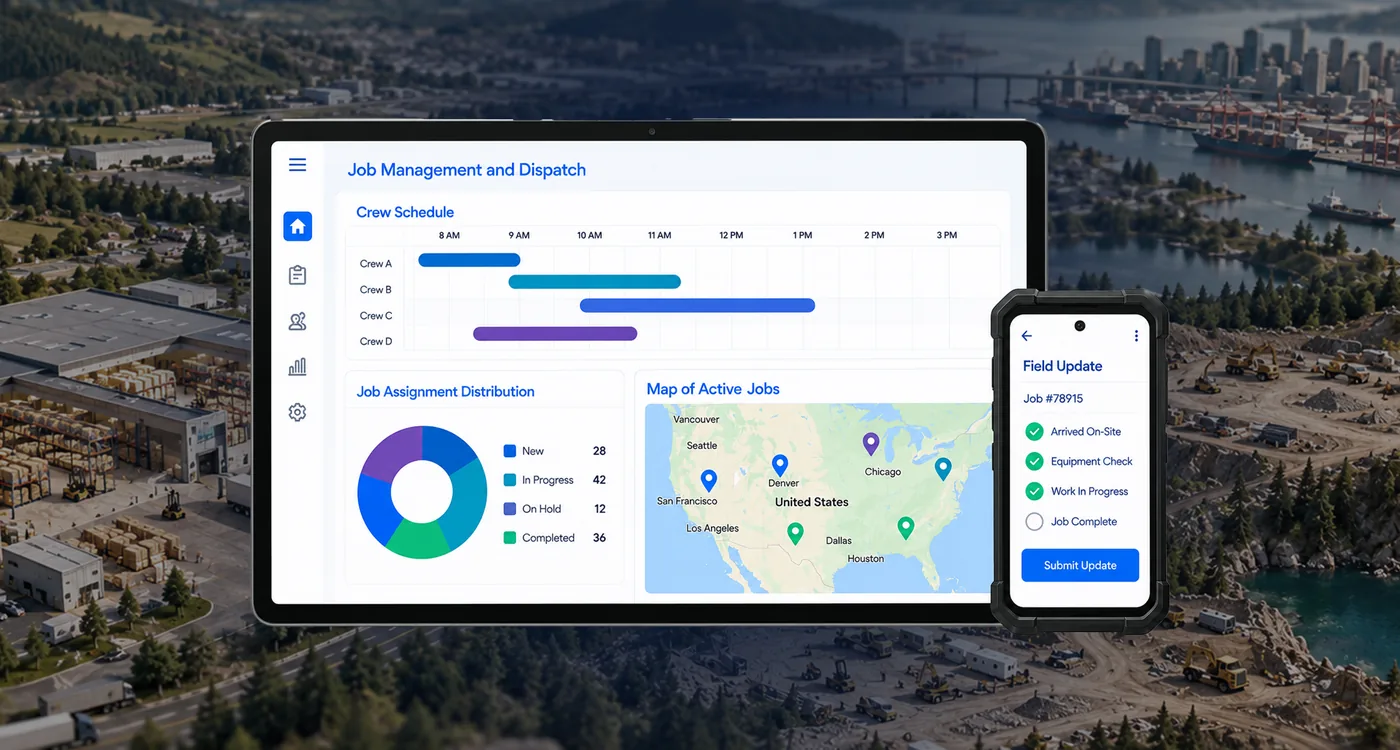
Now, with crew and vendor management, every crew and every job has tracking behind it: the projected schedule, when the team will show up, and team size. If a job of a given scale has a five-person team, Cascade projects two days, times out the schedule, and assigns teams in advance.
With multi-division operations and hundreds of teams, a small coordinating staff now knows where every crew is, what each one is working on, what jobs are coming up and how much each crew is being paid. Most TrackVia customers also track vendors, from supplier lead times that shape job timelines to which contractors perform reliably.
2. Work order management and job profitability
For Cascade, work order management is “where our margins are either made or broken.” In a low-margin business running hundreds of jobs a month, costs can run away quickly. Without job-level detail, a company can end up with ten unprofitable projects and no idea how many will calls or extra material orders caused it.
Cascade now compares material and labor costs against the bid for every job, broken out by trade. A single house can be very profitable on one trade and unprofitable on another, which a job-level total would hide. Jared’s team can see every invoice, cost, and labor figure behind the result, and spot causes such as stolen material or unexpected costs that should be billed to the builder.
The data also changed how leadership works. Decisions used to depend on a corporate leader visiting sites and making observations, which Jared called good directionally but anecdotal. With the data stored in TrackVia, leaders can now plot trends across thousands of data points, and AI tools make that data easier to analyze. Daniel described this as three levels of value: automating field paperwork, giving every stakeholder central visibility, and using the data to decide what to bid and how to deploy crews.
3. Inventory and materials control
“Materials are actually the largest cost center on any given job,” Jared said. Detailed data from TrackVia material control shows Cascade where it can cut waste, for example, running a material at a 10 percent waste factor instead of 15 percent. Those marginal gains add up over time.
TrackVia shows:
- How much should be in stock
- How much Cascade has spent on materials
- What each job is charged for the materials it uses
- Where materials are on delivery trucks on the way to jobs
Nobody has to count the warehouse or visit a site to verify what is there.
4. One pipeline from bid to field
In many companies, the bidding team, the field team, and the construction managers each work from their own assumptions. TrackVia gave Cascade one end-to-end pipeline: the bid, the scope of work agreed with the builder, material planning, and training for field teams and construction managers on that scope.
That changed how Cascade sells. Instead of asking clients what they want, the team presents the options and their costs up front. Because Cascade knows its costs “down to the penny,” it can show a builder exactly how switching materials would change the price. That makes Cascade competitive in its bidding and gives clients confidence in the work.
The data has also widened Cascade’s hiring pool. Its bidding and sales teams come from finance and procurement, and few have construction experience. Jared himself has never installed material on a wall, but he has enough data to make confident decisions.
Three best practices that apply to any field operations software
Hosanna offered three practices from her work with customers across industries:
- Connect the tools you already have. If a tool works for you, keep it. The goal is to get its data into one place in real time, with an audit history, so every stakeholder sees the same picture.
- Build the system around how you work. Every company does things a little differently. Software that forces you into its box makes the work harder and gives up what makes your operation unique.
- Get critical processes out of one person’s head. Hosanna has met customers who cannot take a vacation because they are the only one who knows a process. Automating it makes the work traceable and repeatable, keeps it consistent, and reduces risk.
Where to start
Jared and Hosanna shared advice for teams earlier in the journey:
- Start with what drives revenue. For Cascade, that meant work order management, job management, and managing trades.
- Go for quick wins. A small change that works and saves time is the easiest way to bring executives and owners on board, and momentum builds from there.
- Start with what gets touched the most. Hosanna compared it to cleaning a house: start with the rooms you use every day, not the back closet. Redesigning admin processes can come next.
- Mobile-enable what people already know. Put the familiar paper form on a phone, on one screen, so crews have little new to learn.
The idea that ties the session together is that good field software follows the way people work, and the data it captures then shows the business how to run better. At Cascade, people no longer ask which system something lives in. They come to Jared and ask where in TrackVia they can do it. Watch the full session above to hear the whole conversation.
A question from the audience
How do you get crews who are not comfortable with technology to use it?
Keep it simple and familiar. “We focus on compliance and not on perfection,” Jared said. A system with every feature does not help if nobody uses it. Many of Cascade’s field users are not used to working on phones, so the team builds in the simplest form possible: open TrackVia, tap one button, and everything for the job is on one easy-to-read form.