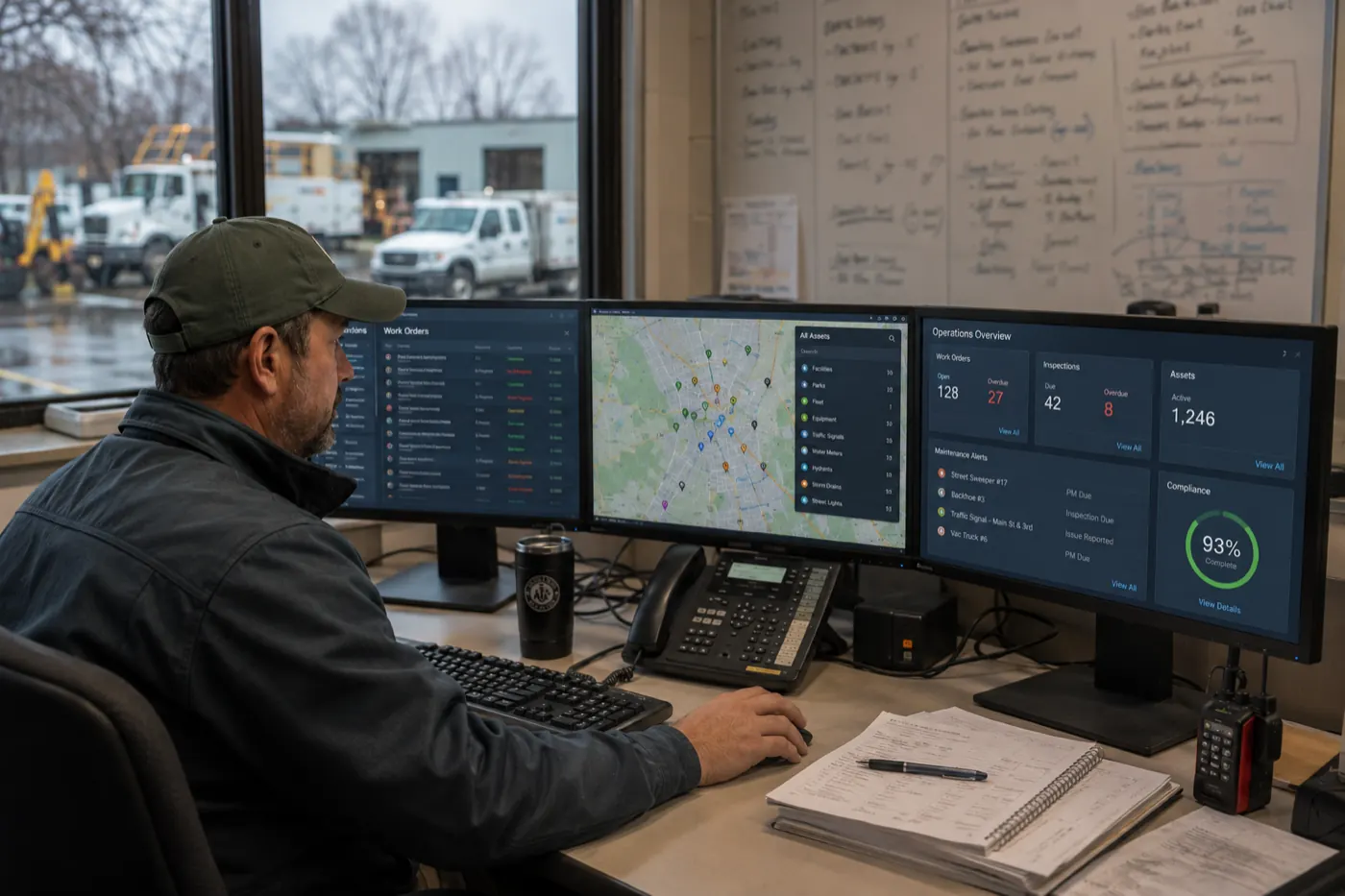
Somewhere between three and five years ago, your team did the responsible thing. The spreadsheets had gotten dangerous: version conflicts, one person who understood the formulas, a monthly reconciliation nobody enjoyed. So you bought a low-code platform, ran an implementation, trained everybody, and moved the work into it. And for a while, that was clearly better.
Then the edges started showing. A workflow that didn’t fit the module, so someone built a tracker beside it. A field crew that needed to work without signal, so they got a second app with a second login. A renewal quote higher than last year’s, for a system that does what it did last year. And then the part that stings: an email thread with an Excel attachment, doing the job the platform was supposed to be doing.
None of that means the original decision was wrong, and it doesn’t mean your team is bad at software. It usually means something simpler: the tool fits most of your operation, and you have been quietly paying for the part it doesn’t fit.
Renewal season doesn’t create the problem. It’s just when the workarounds finally show up on an invoice.
We spend most of our time with operations teams who have already been through one low-code platform migration and are weighing whether to go through another. Here’s the sequence that shows up almost every time, what the workarounds actually cost, the five questions worth answering before you re-sign, and why the spreadsheet coming back is a measurement rather than a discipline problem.
The pattern is the same in almost every low-code platform migration
Different industries, different platforms, different team sizes. The sequence rarely varies:
- The spreadsheets stop scaling, and the team buys a platform to replace them.
- The platform covers most of the workflow. The rest goes somewhere else: the exceptions, the adjacent process, the thing unique to how your operation actually runs.
- Licensing is priced in tiers, so the team pays for a seat count it doesn’t have, or jumps a tier connect another department.
- Field work turns out to need offline capture, and offline turns out to be a separate app, a separate vendor, or a separate line item.
- Renewal arrives higher. Nobody can point to what got better. And the side spreadsheets are back , doing the 20% the platform never absorbed.
Step five is the one worth sitting with. The spreadsheet coming back isn’t a discipline problem, and it isn’t nostalgia. It’s a measurement. It tells you exactly where the platform stopped fitting, and it tells you what your team is willing to do manually rather than fight the tool over.
What the workarounds actually cost
The license fee is the number everyone looks at. It’s rarely the expensive part.
Usage-based pricing grows with your workload, not with your value. In the vertical-specialist corner of the market, pricing frequently keys off volume: projects, contract value, records processed. Read that structure carefully: your cost rises because your business did more work, not because the platform delivered more. A good year becomes a budget conversation.
Offline as a bolt-on is two systems wearing one name. Native offline mobile capture is genuinely uncommon among low-code platforms. Several well-known platforms deliver it by licensing a separate mobile product from another vendor. That works until you’re paying two subscriptions, maintaining the integration between them, and chasing a sync failure across a vendor boundary when a day of inspections doesn’t come back.
And the reconciliation never ends. When part of the process lives outside the system of record, someone re-keys it, accounting cleans up what the field entered twice, and a report gets built by hand because the data lives in three places. That cost never appears on a renewal quote, because it’s paid in your team’s hours instead of your budget line.
Reviewers of the more rigid platforms describe the end state plainly: teams whose work doesn’t match the platform’s core shape “revert to side emails and Excel.” Not abandonment — reversion.
Five things to check before you renew your low-code platform
1. Does the data model match how your operation actually works?
This is the least visible question and the most decisive one. Real operations are full of many-to-many relationships: one site with many assets, one asset inspected by many crews, one crew working across many contracts, one exception touching all of it. Platforms built on flat tables or fixed templates handle that by making you flatten it: duplicate records, a concatenated key field, a naming convention everyone has to remember.
Flattening isn’t neutral. It’s where the data-entry errors come from, and it’s why the missing relationship gets rebuilt in a spreadsheet three months after go-live.
- A relational engine that models many-to-many relationships and connections across applications directly, without a workaround pattern
- Neither extreme: not a blank canvas where you build everything from nothing, and not a rigid vertical suite that fits only one workflow shape
- Opinionated starting templates plus real configurability, so you get a head start you aren’t then trapped inside
- A path for the exceptions, since the exceptions are usually where the margin lives
If your process has to be flattened to fit the tool, your team will rebuild the missing part in a spreadsheet — and you’ll be paying for both.
2. Is offline native, or licensed from somebody else?
Ask the direct version of this question: is the mobile app built by the same company, on the same data model, as the platform? Or is it a partner product with a connector between them?
It matters most on the worst days. The remote site, the basement mechanical room, the rural route, the facility whose Wi-Fi is down because that’s precisely why you’re there. Field capture that only works with a signal is field capture that fails when it counts.
- Photo capture, routing, exceptions, approvals, and reporting all working without a connection, not just a read-only cached view
- Records queued locally and synced on reconnect, with visible sync status so nobody wonders whether the day’s work made it
- One vendor, one login, one system of record, rather than a core platform plus a patched-in mobile app
- No separate contract, and no second integration to maintain, for the capability your field team uses every single day
Your field crews shouldn’t need two logins and a hope for signal.
3. Does the price scale with your operation?
Pricing structure tells you who the platform was designed for. Volume-based pricing means your growth is their upside, on a curve you don’t control and often can’t forecast.
- Growth that tracks the size of your operation, not a forced jump to the next tier because you hired two people
- Renewal math you can model a year out, before you sign, rather than discover
- Structure transparent enough that you can hand it to finance and have them understand it in one pass
Pay for the team you have. Not the team their pricing model assumes you’ll grow into.
4. What happens to the workflows outside the main lane?
Vertical platforms are hard to beat inside their vertical. That’s real, and they’re great for linear use cases. The question is what your operation looks like at the edges of that vertical.
Most companies aren’t one clean workflow. A construction firm also runs fleet, warranty, safety, subcontractor onboarding, and equipment maintenance. A facilities organization runs inspections, route-based service, capital projects, and compliance reporting. A platform built around one industry’s project structure handles the flagship process well and leaves the rest to email.
- One platform that flexes across facilities, route-based services , inspections , and industrial workflows, instead of a point tool per process
- Genuine capacity for the adjacent, custom, and regulated workflows that sit just outside any pre-built model
- Templating, so one region’s or division’s working process can be copied and adapted in an afternoon rather than rebuilt
- An honest inventory: list every process currently living in a spreadsheet or a shared drive, and ask which of them the platform would actually absorb
Great at one thing. Everything else, you’re back to spreadsheets.
5. Can the people who own the process change it?
Every operation needs a change that wasn’t in the original scope: a new field after a near-miss, a new approval step after an audit finding, a new form because a customer wants their inspections documented differently. The only question that matters is how long that takes, and who has to be involved.
If the answer is a vendor ticket, a developer’s sprint, or a professional-services quote, then the real cost of the low-code platform isn’t the license. It’s the changes your team decides not to bother requesting.
- Forms, fields, logic, and routing configured by the program staff who own the process, with no code and no developer queue
- New workflows added without disturbing the ones already running in production
- An interface an inspector or technician can learn in a shift, not a training week
- Automatic assignment and routing, so nobody spends the first hour of the day dividing up a list
- Capture once in the field and it’s in the system of record, with no double entry anywhere in the chain
And what if you work in regulated or federally funded environments?
This part usually belongs to IT and security rather than to operations, but it’s worth knowing before it becomes a blocker. Ask for the specific status, not the adjective: “enterprise-grade” and “certified and reliable” mean nothing without something checkable attached. So here is ours, stated plainly: TrackVia Government is listed on the FedRAMP Marketplace as Certified at Class C (Moderate), effective 23 September 2026. Certification is the FedRAMP designation; an agency Authority to Operate is granted separately by each agency, and the distinction matters when you are comparing vendors, including this one. What exists today, and what your reviewer can actually test: field-level access controls, governance APIs, customer-managed encryption keys, and multi-year audit retention, as platform capabilities rather than premium add-ons.
The reframe: you’re not buying a category, you’re buying a fit
Most low-code platform evaluations are run as a category comparison: feature grids, analyst quadrants, a shortlist of the names everyone already knows. That process is good at telling you which product is most popular. It’s not very good at telling you whether a low-code platform fits the way your operation actually runs, which is the only thing that determines whether the spreadsheets come back.
A more useful evaluation starts from your side: take the three workflows currently living outside your system of record, and ask each vendor to build one.
Build the workflows your operation actually runs, in something flexible enough to change them when you need them changed.
A note on AI, since it’s on every vendor’s slide right now: most operations leaders we talk to aren’t skeptical, they’re in wait mode, blocked by implementation effort and unclear integration rather than by doubt. So the question isn’t which roadmap sounds most ambitious. It’s what works today, whether you can override it, and how it fits the systems you already run. AI that flags an inefficiency and lets a human decide is worth more this quarter than AI that promises to run the process unsupervised next year.
Why teams move to TrackVia’s AI-ready platform
TrackVia is a purpose-built platform for operational workflows : the field, inspection, compliance, and asset processes that end up in spreadsheets because no off-the-shelf product ever fit them exactly.
- A mature relational data model. Many-to-many relationships and cross-application connections are modeled directly, so complex operations don’t have to be flattened to fit.
- Native offline mobile. Built by us, on the same platform, not licensed from another vendor and connected. Capture, photos, approvals, and routing work without a signal and sync on reconnect.
- Configuration by the people who own the process. Program staff change forms, fields, logic, and routing themselves. New processes take hours, not a procurement cycle.
- Pricing that scales with your operation.
- Cross-industry flexibility. One platform across facilities, route-based services, inspections, construction-adjacent, and industrial workflows, including the ones that fall outside any pre-built vertical model.
- Governance built in, not sold up. Field-level access controls, customer-managed encryption, and multi-year audit retention, plus a FedRAMP Marketplace listing as Certified at Class C (Moderate).
- Integrations with what you already run. ERP, GIS, CRM, and reporting systems connect rather than compete.
- One system instead of five. For operations teams, consolidating the side spreadsheets, shared drives, and one-off databases into a single governed place is the largest single gain.
The spreadsheet wasn’t the mistake
Worth saying to the teams doing this work: the tracker somebody built in Excel, the shared drive with the photo folders, the Access database a regional manager wrote a decade ago. None of those were failures. They were people solving a real problem with the tools in front of them, usually with more ingenuity than the situation deserved. Most of what your company actually knows about how its operation runs is encoded in those files.
That knowledge is the asset. The only problem is where it lives: somewhere it can’t scale past one person’s screen, can’t be seen while the work is still happening, and can’t be proven to an auditor a year later.
Moving it isn’t a rebuild. It’s the same process, in a place that bends when your operation changes instead of sending the work back to email or a spreadsheet.
If your team is currently maintaining a spreadsheet beside a platform you’re paying for, that’s the signal. Not a discipline problem your team created, but a fit gap they’ve been quietly covering for.
Bring us the workflow your platform couldn’t absorb. Let’s talk.
The next process change is coming: a new field after a near-miss, a new approval step after an audit finding, a new form a customer asked for. Whether that takes an afternoon or a quarter is decided by the platform you’re on, not by how hard your team works.
So skip the feature tour. Bring the process that’s still living in a spreadsheet beside the system you already pay for, and we’ll show you what it looks like built in TrackVia. Connect with us today.
Frequently Asked Questions
Do we have to replace our current low-code platform to get started?
No, and most teams don’t. The usual starting point is the work that currently lives outside the system of record: the spreadsheets, side trackers, and paper forms. That’s where the pain is measurable and the win is fast. TrackVia integrates with the ERP, GIS, CRM, and reporting systems you already run, so the first build adds a missing capability rather than triggering a migration.
We’re mid-contract. Is it even worth looking now?
Mid-contract is usually the better time. Building one workflow in parallel gives you a real comparison instead of a vendor demo: actual configuration time, actual field adoption, actual data quality. It also means the renewal conversation happens with evidence in hand. Starting the evaluation six weeks before a renewal date rarely leaves room for anything but re-signing.
Will it actually work in the field with no connectivity?
Yes, and this is worth pressing every vendor on. TrackVia’s offline mobile capability is native to the platform, not licensed from a third-party mobile vendor. Records, photos, and approvals are captured offline, queued on the device, and synced when the connection returns. One login, one system of record.
Our workflow is unusual. Is that a problem?
It’s typically the reason teams end up here. Standard processes are well served by off-the-shelf products; the ones that don’t fit a pre-built module are exactly what a configurable relational platform is for. Bring the process that keeps reverting to email. That’s the useful test case.
Who does the building: us, or a services team?
Your program staff, in most cases. Forms, fields, logic, and routing are configured without code, which is what makes same-week changes possible. Our team helps with the first build and the data model so the foundation is right, then after guided training and a walkthrough of our extensive TrackVia University, hands the keys over. The goal is that the people who own the process own the workflow.
What will our security and IT reviewers want to know?
Expect questions about authorization status, access controls, encryption key management, and audit retention. The short version: TrackVia Government is listed on the FedRAMP Marketplace as Certified at Class C (Moderate). Available and testable today: field-level permissions, governance APIs, customer-managed encryption, and multi-year audit trails. Bring IT in early. A platform that consolidates unmanaged spreadsheets into one governed system usually advances their agenda rather than complicating it.