
Why operations teams pick TrackVia
Four things usually decide it: the numbers behind the platform, real results from customers running it today, what makes it technically different, and where security and compliance stand. Here is where TrackVia stands on each.
Production applications
Running real operations today
Field submissions a month
Workflows moving through from the field
Operational records
Managed on the platform
Uptime
Commercial, Government and HIPAA environments
Scale you can check, not a category claim
Every platform in this market says it is flexible and enterprise-ready. These are the figures underneath that sentence.
- More than 3,000 applications in production running the work today
- Over 500 million operational records managed
- Shaped by the work of more than 2,800 practitioners who have built and configured applications on the platform
- Approximately 10,000 field submissions a month
- 99.99% uptime across commercial, government and HIPAA environments
- More than 6,000 systems and data sources connect through integrations, a full REST API and webhooks
- Workflows live in 30 days
What it changed for teams already running it
Three operations, three different industries, and the change each one measured.
10x expected return
Downer
Downer connected work orders, field updates, equipment and inventory into one system. Projects that used to lose weeks to disconnected work now complete in hours, and the company expects a 10x return on the investment.
Read the full case study45 minutes to 5
Two casino operators
Two casino operators connected previously separate compliance and security systems into one current view of the patron. Response time from a security flag to human intervention dropped from up to 45 minutes to 5, with staff reporting better guest insights along the way.
Read the full case studyFrom a failed rollout to on time
KS Industries
KS Industries replaced paper checklists at remote job sites, some hundreds of miles from headquarters, with an offline-capable mobile app, after a previous off-the-shelf system had failed. The team now runs on time, with centralized safety reporting and improved margins.
Read the full case studyWhat makes the platform technically different
These four capabilities set TrackVia apart from the competition.
True offline mobile
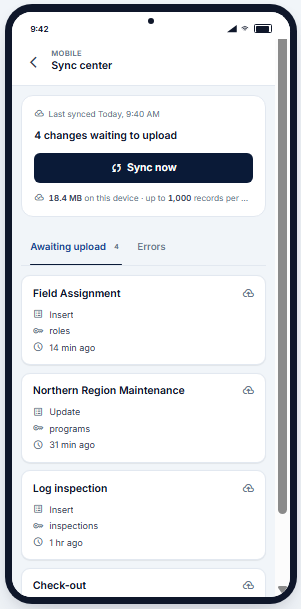
Most competitors in this category are connected-only or offer limited offline support. TrackVia’s mobile app is offline-first: a crew captures work with no signal at all, and it syncs the moment a connection returns. More in the Mobile section below.
Enterprise-grade access control
Permissions go down to the role, the record, the field and the view, not just a simple on-or-off switch, closer to what enterprise IT expects than most platforms in this category offer.
Regulated-industry deployment tiers
Private and HIPAA-compliant environments are available today, and a separate government environment is FedRAMP Class C (Moderate) Certified. That opens healthcare, government and other compliance-sensitive work many platforms in this category are not built to serve. See Security and compliance below for exactly where each one stands.
Workflow as a first-class concept
Workflow stages, transitions and the permissions at each step are built into the platform itself, not bolted on afterward. If you think about your operation as work passing through stages, the system already thinks that way too.
The app is the product, not a viewer for it
Most platforms treat mobile as a window onto what a desktop already captured. In TrackVia, the app is where the record is made. Photos, notes, checklists, e-signatures and barcode scans are captured on the spot, each one timestamped and geotagged as it is taken.
And it works with no signal at all. A crew in a basement, on a plant floor, or forty miles past the last tower captures exactly what they would capture at the office, and it syncs the moment a connection comes back. That is the difference between a record written while someone was standing in front of the problem and one written from memory that evening.
See it on a phone
Built to pass the review, not to argue with it
Two environments, with different obligations. Knowing which one a deployment sits in is usually the first question a security reviewer asks.
The commercial platform
- SOC 2 Type II
- HIPAA environments, alongside commercial and government, at 99.99% uptime
- Every configuration change recorded in an audit log, with bulk changes previewed and backed up automatically before they run
TrackVia Government
- A separate environment from the commercial product, hosted on Second Front’s Game Warden platform, which is built to handle Controlled Unclassified Information
- Implements the FedRAMP Class C (Moderate) control baseline, maintained through continuous monitoring and regular assessment
- SOC 2 Type II
Where FedRAMP actually stands
TrackVia Government is listed on the FedRAMP Marketplace as Certified for FedRAMP Class C (Moderate) under the Agency path, in the Ongoing Certification phase, effective 23 September 2026.
Game Warden, the platform TrackVia Government runs on, holds its own FedRAMP Class D (High) authorization. That authorization belongs to Second Front, not to TrackVia, and running on an authorized platform is not the same as holding an authorization.
Certification is the FedRAMP designation; an Authority to Operate is granted separately by each agency. An agency works with its own authorizing official and our team to issue or reuse an ATO against the certified environment, and it is the agency’s AO who makes that call. The government page answers this in more detail, and the Marketplace listing is the authoritative source for status on any given day.
See it against your own workflow
Bring the process that is currently held together by a spreadsheet and three email threads. That is the one worth looking at.
Talk with an expert